On Feb 11th we drove south of Casa Grande toward Tucson to visit Picacho Peak State Park. Picacho Peak is a dramatic geological rocky protrudence with a unique shape that rises 1500 feet above the desert floor, reaching an elevation of 3,374 feet at the peak. It can be seen for miles around, and has likely been used as a landmark by travelers since prehistoric times. One of the first written records was in the 1700's when the Anza Expedition passed through this area.
It has historical significance as the site of a battle during the Civil War. A monument placed there commemorates this event. A re-enactment of the battle takes place the second week in March.
The 3500 acre site has seven miles of developed hiking trails that wind through the saguaro cacti and other desert plants. There are picnic areas, campsites, interpretive signs, and a visitor center on site.
Monday, February 27, 2012
Sunday, February 19, 2012
SkyDive Arizona
SkyDive Arizona is advertised as the largest skydiving center in the world...we were told by numerous RV Park residents that we had to drive to Eloy, AZ and check it out, so on Friday, Feb 10th we drove the 20 or so miles to Eloy and watched the skydivers...it was amazing!
SkyDive Arizona is a training facility for individual and team skydivers...they also offer tandem jumps with an instructor for those brave enough to jump out of a plane at 13,000 feet, free-fall for one minute, then deploy the parachute and glide to earth. (Neither of the Jax's were up for that!)
Also on site is a freefall simulator...that looked to be more fun! The simulator generates wind speeds of up to 120 miles per hour in an enclosed chamber...you gear up, step into the chamber, and experience the "free-fall" sensation, suspended a couple feet above the floor of the chamber. We were able to watch several individuals, including a group of young children, use the simulator.
The fields and simulator are often used for military training. The day we visited there was a group of about 20 members of the Royal Air Force from England doing practice jumps.
We spent a couple hours there watching the jumpers glide to earth...at times there would be a dozen or more in the sky at once, all with colorful jumpsuits & parachutes. Everyone we watched made a safe landing!
SkyDive Arizona is a training facility for individual and team skydivers...they also offer tandem jumps with an instructor for those brave enough to jump out of a plane at 13,000 feet, free-fall for one minute, then deploy the parachute and glide to earth. (Neither of the Jax's were up for that!)
Also on site is a freefall simulator...that looked to be more fun! The simulator generates wind speeds of up to 120 miles per hour in an enclosed chamber...you gear up, step into the chamber, and experience the "free-fall" sensation, suspended a couple feet above the floor of the chamber. We were able to watch several individuals, including a group of young children, use the simulator.
The fields and simulator are often used for military training. The day we visited there was a group of about 20 members of the Royal Air Force from England doing practice jumps.
We spent a couple hours there watching the jumpers glide to earth...at times there would be a dozen or more in the sky at once, all with colorful jumpsuits & parachutes. Everyone we watched made a safe landing!
Queen Creek Olive Mill
The olive trees are drip irrigated; no pesticides or mold inhibitors are needed due to this region's growing conditions. Trees grow buds in March and blossom mid-April. By May the olives are formed on the tree; they are allowed to grow through the summer. Harvest is in the fall.
Olives are harvested by hand using special rakes to remove the fruit from the trees. After harvest, the olives are washed with fresh water and ground into a coarse paste using a hammer mill. The paste is slowly mixed to allow small oil drops to stick together and form larger ones. A centrifugal decanter is then used to separate the oil. The oils are stored in large stainless steel vats until they can be blended and bottled.
At the end of the tour we were given samples of different blends, and encouraged to shop in their market for bottles to enjoy at home.
Monday, February 6, 2012
RV Park Activities
In case you are wondering, we are keeping busy here at the RV Park...Kathy has been taking part in Walk Aerobics classes held Monday, Wednesday, and Friday mornings. Tuesday and Thursday, we both have been playing shuffleboard. Every Monday morning there is a park meeting where activities for the week are presented, and problems/concerns addressed. They also provide coffee & donuts! Monday evening is Music Night, with entertainment provided by musicians from the park. Many of the selections are "sing along" with a song book provided. Wednesday night is Wii Bowling. Almost every Friday night there is entertainment by an outside group. Anyone who wants can attend for a small fee. The night we attended there was a very enthusiastic bluegrass band playing.
Breakfasts are served every other Saturday morning. We learned quickly that if you show up at the scheduled time for food events, you are already at least 15 minutes late! One evening there was a cook-out in the desert next to the park; this event is BYOB & C (bring your own beverage and chair); they served hamburgers, brats, and hotdogs, then started large bonfires to sit around and visit with your neighbors.
Other tag-a-long events are constantly being scheduled...this month (February) we are going to an olive mill to learn about olive oil processing; and a chartered lake cruise on Saguaro Lake.
Daily walks around the park and visiting neighbors complete our park events.
Breakfasts are served every other Saturday morning. We learned quickly that if you show up at the scheduled time for food events, you are already at least 15 minutes late! One evening there was a cook-out in the desert next to the park; this event is BYOB & C (bring your own beverage and chair); they served hamburgers, brats, and hotdogs, then started large bonfires to sit around and visit with your neighbors.
Other tag-a-long events are constantly being scheduled...this month (February) we are going to an olive mill to learn about olive oil processing; and a chartered lake cruise on Saguaro Lake.
Daily walks around the park and visiting neighbors complete our park events.
Wednesday, January 11, 2012
Casa Grande Ruins
On January 9th we visited Casa Grande Ruins National Monument, the site of the archeological remains of an ancient Hohokam farming village. At the center of the site is the "Great House", remains of a structure estimated to have been 4 stories high and 60 feet long. It was constructed of desert subsoil mud called caliche, timbers from huge juniper, fir, or pine trees carried from the rivers as far as 60 miles from the site, and large cactus found on the desert.
Smaller pit houses were also located around the large structure. The entire village seemed to have been surrounded by a mud wall. (The tour guide joked this was probably Arizona's original "gated community")
The Hohokam were hunter-gatherers who likely inhabited this area from 300 to the 1400's. They drew from Mesoamerican civilizations, traded their pottery and jewelry for shells, mirrors, copper items, and Macaws from Mexico. They learned to channel water from nearby rivers through intricate irrigation canals and grew corn, beans, squash, tobacco, cotton, and agave. Other sources of food were the desert plants and animals found around the settlement.
The Great House was constructed so it's four walls faced the four cardinal points of the compass. Circles and other openings in the walls aligned with celestial events, like the setting sun on the day of summer solstice, or different phases of the moon and stars during the year.
The village seemed to have been abandoned in the 1400's; it was discovered in the late 1600's by missionaries; then found again in the late 1800's. Travelers to the west in search of gold carved their names and other graffiti in the soft stone. In 1892 it was designated an archeological preserve to be protected from further damage.
The site is now maintained by the National Park Service.
Smaller pit houses were also located around the large structure. The entire village seemed to have been surrounded by a mud wall. (The tour guide joked this was probably Arizona's original "gated community")
The Hohokam were hunter-gatherers who likely inhabited this area from 300 to the 1400's. They drew from Mesoamerican civilizations, traded their pottery and jewelry for shells, mirrors, copper items, and Macaws from Mexico. They learned to channel water from nearby rivers through intricate irrigation canals and grew corn, beans, squash, tobacco, cotton, and agave. Other sources of food were the desert plants and animals found around the settlement.
The Great House was constructed so it's four walls faced the four cardinal points of the compass. Circles and other openings in the walls aligned with celestial events, like the setting sun on the day of summer solstice, or different phases of the moon and stars during the year.
The village seemed to have been abandoned in the 1400's; it was discovered in the late 1600's by missionaries; then found again in the late 1800's. Travelers to the west in search of gold carved their names and other graffiti in the soft stone. In 1892 it was designated an archeological preserve to be protected from further damage.
The site is now maintained by the National Park Service.
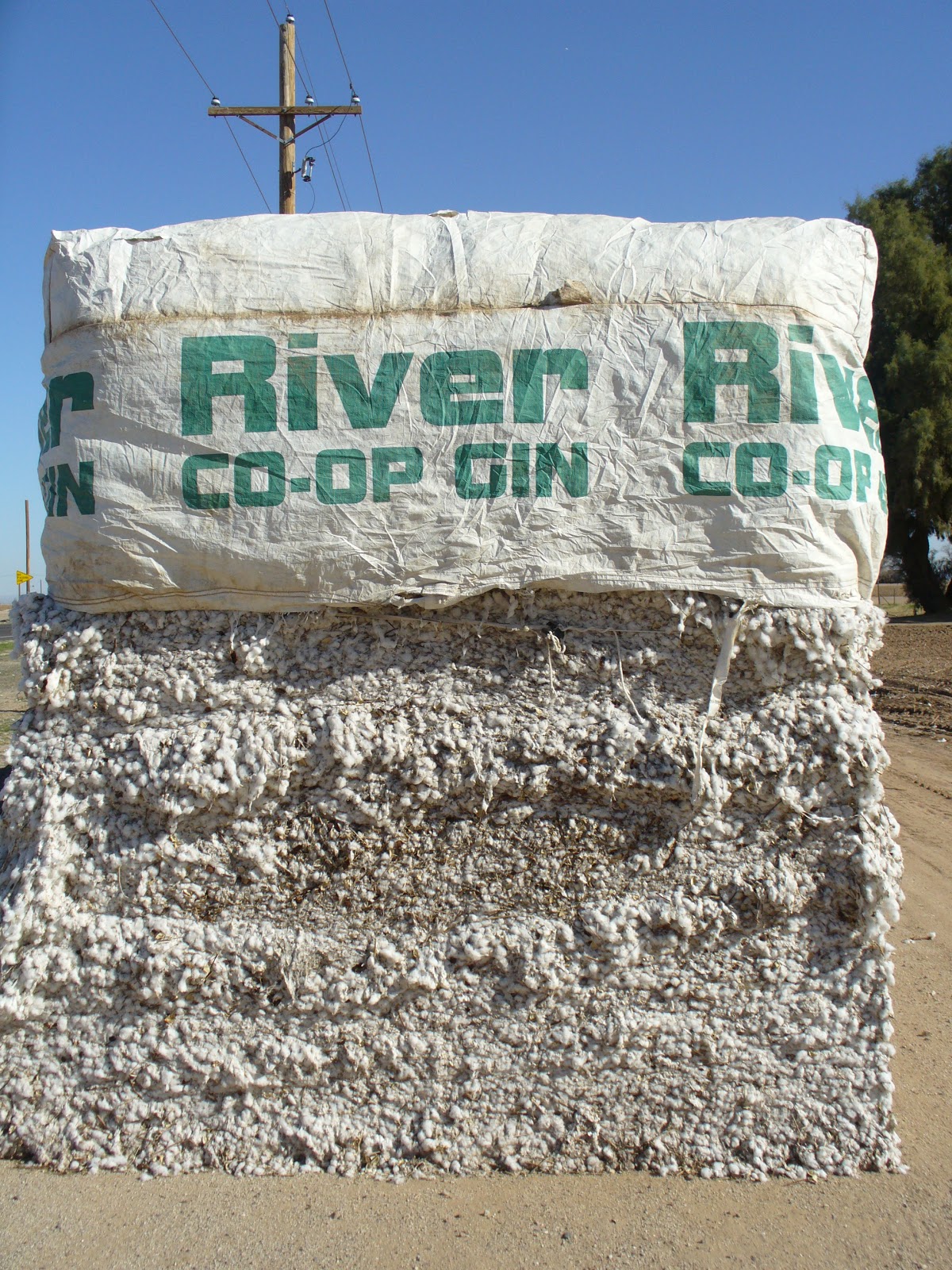
Cotton Farm Tour
It was an interesting day for a couple of old farm kids!
Thursday, January 5, 2012
Arizona or Bust
Arizona is our winter destination this year; we departed Shoreview on Dec 28th and headed South. The trip to Arizona took many days with many stops in-between. Travel temperatures were warmer this year than last, so we were able to look for campgrounds that were open, and spent evenings in our motorhome, rather than hotels.
The first night we spent at Terribles Lakeside Casino RV Park in Osceola, Iowa. Other MN travelers were there too. From there our travels took us to Emporia, Kansas, where we spent an evening in a RV park located between the Kansas Turnpike and a very busy railroad line...then on to Guymon, Oklahoma which had a couple RV parks, but both were encased in mud from the melting snowstorm afew days earlier. That evening we opted for the Walmart parking lot!
On New Years Eve day we left Guymon in hopes of driving to Albuquerque by the next evening. Instead strong gusty winds drove us off the interstate early afternoon, and we spent New Years Eve in an RV park in Santa Rosa, NM. The winds calmed overnight; our next stop was Deming, NM. On the way to Deming we passed through Hatch, NM the Chili Capitol of the USA...there were chili peppers and restaurants serving spicy delights everywhere! Finally on Monday, Jan 2nd we arrived in Casa Grande, Arizona, our final destination.
After a couple days of checking out parks, we moved to our new "home base" in Casa Grande today...now we can start sightseeing...
The first night we spent at Terribles Lakeside Casino RV Park in Osceola, Iowa. Other MN travelers were there too. From there our travels took us to Emporia, Kansas, where we spent an evening in a RV park located between the Kansas Turnpike and a very busy railroad line...then on to Guymon, Oklahoma which had a couple RV parks, but both were encased in mud from the melting snowstorm afew days earlier. That evening we opted for the Walmart parking lot!
On New Years Eve day we left Guymon in hopes of driving to Albuquerque by the next evening. Instead strong gusty winds drove us off the interstate early afternoon, and we spent New Years Eve in an RV park in Santa Rosa, NM. The winds calmed overnight; our next stop was Deming, NM. On the way to Deming we passed through Hatch, NM the Chili Capitol of the USA...there were chili peppers and restaurants serving spicy delights everywhere! Finally on Monday, Jan 2nd we arrived in Casa Grande, Arizona, our final destination.
After a couple days of checking out parks, we moved to our new "home base" in Casa Grande today...now we can start sightseeing...
Subscribe to:
Posts (Atom)